Showing posts with label European colonisation. Show all posts

Monday, December 20, 2021

Wangari Maathi Planted Millions of Trees as a Form of Resistance and Empowerment

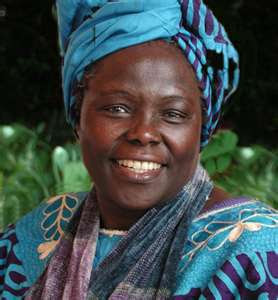
Wangari Maathi
Check out this piece on Wangari Maathi, The Woman Who Planted Millions of Trees.  As a child growing up in Kenya, she saw the colonial settlers chop down trees in order to grow cash crops such as tea.  Later on after colonisation effectively ended, she saw Kenyans do the same thing in order to survive.  

At that time, girls were rarely educated, but Maathi's mother made sure she got an education.  

I found this piece very inspiring, and I trust that you will, too.  

Trees connect us to something elemental in nature, and to our own elemental nature.  


For more about trees, check out this poem by Ursula K. LeGuin, and this one by Mary Oliver.  

What is your relationship with trees like?  Please post your answer below and please share this with your networks.  Thanks.  


Friday, July 01, 2016

Remembering the Somme

African American soldiers in WWI
Today marks the centenary of the first day of the Battle of the Somme. Growing up in the States, I didn’t know much about the First World War. I had never heard the names of the great battles such as Verdun, Gallipoli, Passchendaele and, of course, The Somme. I learned a lot of detailed information when I moved to the UK.

This information was not taught when I was in school in the States, probably because we did not enter the war until 1917. So we missed out on The Somme, although our men experienced the final two years of the conflict.

Black nurses at Camp Grant WWI
World War I is remembered for the senseless slaughter of the combatants. The battle of The Somme went on for 141 days and saw the deaths of a million soldiers on all sides of the conflict. Young men were sent to their deaths by generals who either were incompetent or just did not care about the lives being squandered – or possibly both.

World War I was a new kind of war, relying on trench warfare and heavy artillery. The doctors and nurses who treated the wounded saw types of wounds they had never witnessed before. And the killing was on a scale that had never occurred before.

It is important that we remember The Somme and the men and women who gave their lives during the war. Many of them came from Africa, the Caribbean and India.

I was not aware of the horrendous conditions in which Black soldiers who served in the British Army lived. For example, in France, the African Caribbean soldiers in the British Army slept in unheated tents, while captured German enemy soldiers were given heated accommodation in barracks. For more about this, see Black People in the First World War. Many men joined up in the naive belief that serving in the army, and "proving themselves" would lead to them experiencing less racism and racial discrimination at home.  

World War One was meant to be the war to end wars, but if we look at the conflicts in places such as Iraq, Syria, Afghanistan and northern Nigeria today, it is clear that war is still alive and well.

Much of the fighting took place on the African continent, and some of the conflicts taking place in Africa over the past two decades have their origins in the First World War. So is much of the poverty and deprivation still being suffered by people in Africa today. For more about this, see Black People in the First World War.

I was aware that the First World War ushered in a period of great change for many African Americans. Many of the men who had served in the war and experienced being treated as equals – for example, being allowed to sit and drink in cafés in France, something we all take for granted today – returned home to the States expecting and demanding equal treatment. This was one factor that contributed to the epidemic of lynchings in the South that began in 1919 and, of course, led to many African Americans migrating North. So the First World War had a huge impact on the lives of Black people all over the world.

I have a lifelong commitment to nonviolence. We must end violence and put an end to these conflicts that are still destroying the lives of millions today. 
The images above were taken from World War I and the African American experience.   


Monday, August 17, 2015

The Sowetan – Jumping the Border for Water

The Sowetan - Jumping the Border for Water
The Sowetan newspaper reports Botswanan women routinely jump the border with South Africa in order to collect water for their families.  You may be able to access it here at The Sowetan e-edition: http://www.pressdisplay.com/pressdisplay/viewer.aspx

This is an artificial border first erected in 1933, which divided a community called Mabule in Botswana .  Now half of Mabule is in South Africa, but the other half is still in Botswana. And they need water. They cross the barbed wire border every day to get it. 

I don't remember hearing about this in The No. 1 Ladies' Detective Agency.   

As you may know, during the European colonisation of Africa, many artificial borders were set up and they often divided communities. There are people in Mabule in Botswana who are now living in a different country from their relatives – all because of an artificial border.

Similar things have happened all over Africa. And this is still affecting people to this day.

Think about the devastation that is being wrought by Boko Haram in Northern Nigeria and reflect on how much of this can be traced to the fact that areas which are now banded together nationally as Nigeria were once separate territories, with their own poitical and economic systems. These existing systems were either eroded or destroyed in order to facilitiate the agendas of the European colonisers. For more about this, check out my blog post:  Invasion 1897.  

For more about the devastating long-term effects of the European colonisation of Africa, see: Black People in the First World War. 

Please share this with your networks.  Thanks.   

Thursday, October 09, 2014

World War One: The Crucial Battle for Togo

Map of colonised Africa 1914
I watched this very interesting short film on the BBC today. 

The wireless station at Kamina in Togo, West Africa, was a crucial centre for German communications.  Built by a huge workforce of African men and women during the German occupation, the station allowed the German colonisers to communicate with their home country and with Asia.

This is just one of many examples of how African labour, land and resources were exploited by European colonisers during the war. 

See also:  Black People in the First World War. 

Tuesday, October 07, 2014

Black History: Break the Silence Congo Week 2014

Mutilated in Congo
In the 19th century, under the rule of King Leopold II, Congolese people were enslaved, forced to work in their own country, which had been turned into the king's private estate, and mutilated when they failed to meet the quotas that had been set for rubber extraction. 

For a fifth year, Black History Studies will take part in the Break the Silence Congo Week for Black History Month. 

The purpose of the Break the Silence Congo Week is to raise consciousness about the devastating situation in the Congo and mobilize support on behalf of the people of the Congo. 

Click here for details.  

For lots more Black history images, see:  African Images and Black History International on Pinterest.